
Why Abacus Training Gives Children a Lifelong Advantage
Introduction: The Ancient Tool with Modern Benefits
The abacus is one of humanity's oldest calculating instruments, dating back over 2,500 years to ancient Mesopotamia. Despite the rise of calculators and computers, abacus training has seen a remarkable resurgence worldwide. According to the Universal Concept of Mental Arithmetic System (UCMAS), over 6 million children across 80 countries are currently enrolled in abacus-based mental math programs. The reason is simple: abacus training does not just teach children to calculate, it fundamentally reshapes how their brains process information.
In Nepal, interest in abacus training has grown steadily as parents seek ways to give their children a competitive academic edge. At Prime Learning in Pokhara, our abacus mental math program helps children aged 4 to 14 develop skills that benefit them far beyond mathematics. This article explores the science behind abacus training, its measurable cognitive benefits, and why it gives children an advantage that lasts a lifetime.
How Abacus Training Works
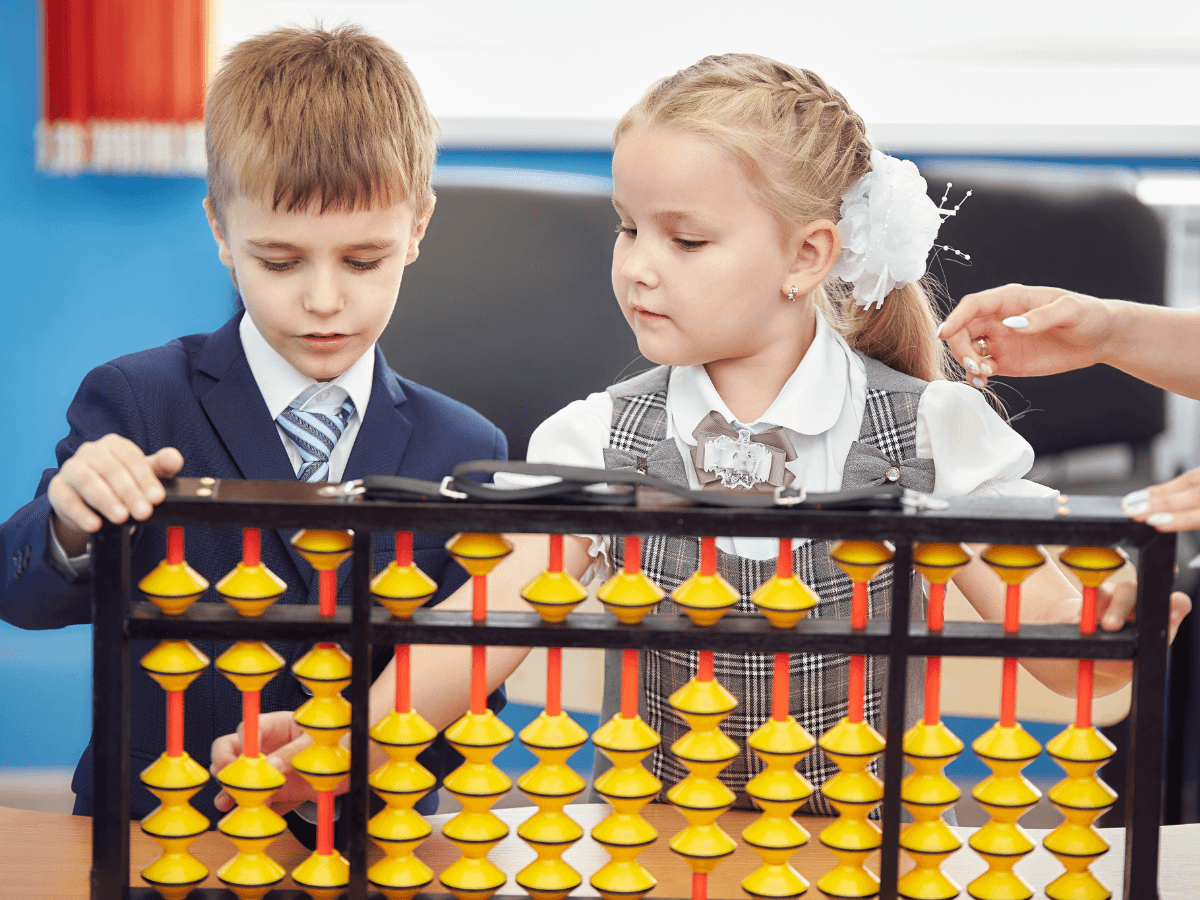
Abacus training begins with physical bead manipulation. Children learn to represent numbers using rows of beads on a wooden or plastic frame. As they progress, they gradually transition to performing calculations by visualizing the abacus in their mind, a technique known as mental abacus or anzan.
This mental visualization engages both hemispheres of the brain simultaneously. The left hemisphere handles logical processing and number recognition, while the right hemisphere manages spatial visualization and pattern recognition. Research published in the Frontiers in Neuroscience journal has shown that abacus-trained children develop stronger neural connections between brain hemispheres compared to their peers.
The Stages of Abacus Learning
| Stage | Skills Developed | Typical Duration |
|---|---|---|
| Foundation | Bead recognition, basic addition and subtraction on the physical abacus | 4-6 weeks |
| Intermediate | Multi-digit operations, introduction to mental visualization | 6-8 weeks |
| Advanced | Full mental arithmetic without physical abacus, speed drills | 8-12 weeks |
| Mastery | Complex multi-step calculations, competition-level speed and accuracy | Ongoing practice |
At Prime Learning, our three-month program covers the first three stages, giving students a strong foundation in both physical and mental abacus techniques.
Scientifically Proven Cognitive Benefits
Abacus training has been the subject of extensive academic research. The benefits go well beyond faster arithmetic. Here are the key cognitive advantages supported by peer-reviewed studies:
1. Improved Working Memory
A study by Bhaskaran et al. published in the National Library of Medicine found that children who received abacus training for one year showed a 20% improvement in working memory compared to a control group. Working memory is critical for reading comprehension, problem-solving, and following multi-step instructions.
2. Enhanced Concentration and Focus
Mental abacus practice requires sustained attention to visualize and manipulate bead positions internally. Over time, this trains children to maintain focus for longer periods. Parents commonly report improvements not just in math, but in all subjects that require concentrated study.
3. Greater Numerical Fluency
Abacus-trained children develop an intuitive sense of number relationships. They understand place value, estimation, and number patterns more deeply than children who rely solely on written methods or calculators.
4. Boosted Confidence in Mathematics
Many children develop math anxiety early in their schooling. Abacus training combats this by giving children a reliable mental tool for calculation. When a child can mentally solve problems faster than their peers, their confidence in math grows significantly.
Key Research Findings at a Glance
| Benefit | Research Finding | Source |
|---|---|---|
| Working Memory | 20% improvement after 1 year of training | Bhaskaran et al., 2006 |
| Calculation Speed | Abacus students solved problems 40% faster | Hatano et al., 1977 |
| Academic Performance | Higher scores in math, science, and language | Amaiwa & Hatano, 1989 |
| Brain Activation | Bilateral brain hemisphere engagement during mental arithmetic | Hanakawa et al., 2003 |
The Ideal Age to Start Abacus Training
Most experts recommend starting abacus training between ages 4 and 8. During this window, children's brains are highly plastic and form new neural pathways rapidly. However, children up to age 14 can still gain substantial benefits from the training.
The Brain Balance Achievement Centers note that early cognitive training during the formative years has compounding effects: skills learned during this period become deeply ingrained and automatic, requiring less conscious effort as the child grows older.
Recommended Starting Ages
| Age Group | Focus Areas | Expected Outcomes |
|---|---|---|
| 4-6 years | Number recognition, basic bead manipulation, counting games | Strong number sense, comfort with math concepts |
| 7-9 years | Addition, subtraction, introduction to mental abacus | Faster calculation, improved school grades |
| 10-14 years | Multi-digit operations, multiplication, division on abacus | Competition readiness, advanced mental math |
Abacus vs. Calculator: Why the Old Tool Wins for Learning
Parents sometimes ask: why learn the abacus when calculators are everywhere? The answer lies in the difference between using a tool and developing a skill. A calculator gives you an answer; abacus training gives you the ability to think mathematically.
- Active vs. passive learning: Using a calculator is passive. The child inputs numbers and reads a result. Abacus training requires active mental engagement, visualization, and sequential reasoning.
- Error detection: Abacus-trained children develop number sense that helps them estimate answers and catch errors, a skill that calculator users often lack.
- Transferable skills: The concentration, memory, and visualization skills from abacus training transfer to other academic areas. Calculator use does not build these cognitive abilities.
- Exam readiness: In Nepal's school examination system, students cannot use calculators. Mental math fluency gives abacus-trained students a significant advantage during timed exams.
Abacus Training in Nepal's Educational Context
Nepal's education system, governed by the Ministry of Education, Science and Technology, emphasizes mathematics at every level from primary school through the SEE (Secondary Education Examination). Students who struggle with basic arithmetic often fall behind in higher-level math and science subjects.
Abacus training addresses this directly by building a strong arithmetic foundation early. In Pokhara and across Nepal, abacus programs have become popular supplementary education options. Prime Learning's program is designed to align with Nepal's school curriculum, so the skills children develop directly support their classroom learning.
How Abacus Skills Map to Nepal's Curriculum
| Class Level | School Math Topics | How Abacus Helps |
|---|---|---|
| Class 1-3 | Basic counting, addition, subtraction | Number sense, speed, confidence with fundamentals |
| Class 4-6 | Multiplication, division, fractions | Mental calculation of multi-digit problems |
| Class 7-10 | Algebra, geometry, word problems | Working memory, pattern recognition, estimation |
What to Expect from Prime Learning's Abacus Program
Our three-month abacus mental math program in Pokhara is structured for children aged 4 to 14. Here is what the program includes:
- Structured curriculum: Progressive lessons from bead basics to full mental arithmetic
- Small class sizes: Maximum 12 students per batch for individual attention
- Regular assessments: Weekly speed tests and accuracy checks to track progress
- Practice materials: Take-home worksheets and flash cards for daily practice
- Flexible scheduling: Weekday and weekend batches available
Most parents notice visible improvements within the first month: children become faster with basic calculations, more confident with homework, and more attentive during study time.
Abacus and Competitive Examinations
Students who train on the abacus gain a significant advantage in competitive exams. In Nepal, timed examinations like the SEE, entrance exams for engineering and medical colleges, and various scholarship tests all require quick and accurate calculations. Students who can mentally compute answers save valuable time that they can redirect toward more complex questions.
International abacus competitions, organized by bodies like UCMAS and the World Abacus Mental Arithmetic Association (WAMAA), provide students with opportunities to test their skills against peers from dozens of countries. Participating in such competitions builds resilience, discipline, and a sense of achievement that extends far beyond mathematics.
Popular Abacus Competitions
| Competition | Organized By | Participants |
|---|---|---|
| UCMAS International Competition | UCMAS | Students from 80+ countries |
| WAMAA World Championship | World Abacus Mental Arithmetic Association | Regional and national qualifiers |
| SIP Abacus National Competition | SIP Academy | Students across South Asia |
Facts and Figures: Abacus Training Worldwide
| Statistic | Detail |
|---|---|
| Countries with abacus programs | 80+ |
| Students enrolled globally (UCMAS alone) | Over 6 million |
| Typical training duration | 3-12 months |
| Ideal starting age | 4-8 years |
| Calculation speed improvement | 30-50% faster than untrained peers |
| Brain areas activated | Both left and right hemispheres simultaneously |
| Working memory improvement | Up to 20% after sustained training |
Tips for Parents: Supporting Abacus Learning at Home
Abacus training works best when it is reinforced outside the classroom. Here are practical tips for parents to support their child's progress:
- Daily practice: Even 10-15 minutes of daily practice makes a significant difference. Consistency matters more than duration. Set a fixed time each day for abacus practice.
- Use flash cards: Flash card drills help children practice speed and accuracy. Start with simple single-digit problems and gradually increase difficulty as the child improves.
- Make it fun: Turn practice into games. Time challenges, family math competitions, and rewards for milestones keep children motivated and engaged.
- Avoid calculator dependence: Encourage mental calculation for everyday situations like shopping totals, tip calculations, or counting change. Real-world practice reinforces classroom learning.
- Be patient: Progress in abacus training is not always linear. Some stages take longer than others. Celebrate effort and improvement rather than demanding perfection.
Conclusion: An Investment in Your Child's Future
Abacus training is one of the most effective investments you can make in your child's cognitive development. The benefits, including stronger memory, better concentration, faster calculation, and greater academic confidence, compound over time and extend well beyond mathematics.
Whether your child is struggling with numbers or already performing well and looking for an extra edge, abacus training provides measurable, lasting advantages. The skills learned through mental abacus practice become deeply embedded cognitive tools that support learning throughout school and into professional life.
At Prime Learning in Pokhara, we have seen hundreds of children transform their relationship with mathematics through our abacus program. If you would like to learn more or enroll your child, contact us today or visit our courses page for details.